Connecting Families to the Expanded Child Tax Credit: What We Learned
In the fall of 2021, the Coalition on Human Needs (CHN) and Partnership for America’s Children came together to launch a national Child Tax Credit (CTC) outreach project. We joined this project as Child Tax Credit Outreach Coordinators, bringing our prior experience in community organizing and outreach. We had spent years working with many of the same communities with which we sought to connect through our CTC outreach. This previous experience and the relationships and expertise that CHN and the Partnership had built through past work together, helped us reach families across the country.
The American Rescue Plan Act of 2021 expanded the CTC to include families with no income. It increased the amount of the credit and made it “fully refundable,” allowing families without tax obligations to get the full amount of the credit. While millions of families automatically received monthly advance payments from the IRS in 2021, families whose incomes were usually below the filing threshold and therefore did not regularly file tax returns, were required to take extra steps to get their money. This was because without up-to-date information, the IRS could not automatically send payments to these new or intermittent filers, leaving millions of children in families with no or low income at risk of missing out on the credit. Through our outreach, we supported trusted institutions and community partners in helping families claim the 2021 expanded CTC. Please read below for lessons learned through our efforts to reach these families.
What worked well?
A two-pronged approach
We found that it was effective to pursue a two-fold strategy of 1) high-volume outreach through school districts and government agencies, and 2) deeper engagement of trusted community partners.
Large entities, like public benefits agencies, have the capacity to reach tens of thousands of families at once and have consistently been shown to be especially effective messengers for communicating with families about the CTC. After reviewing the results of their simplified filing website in 2021, Code for America noted that “direct messages from benefits agencies (or adjacent groups) to their beneficiaries were the single easiest way to efficiently reach new non-filers and successfully get them to claim their tax benefits.” This aligned with our findings from focus groups we conducted about the CTC in 2021. Simplified filing – which provided an easier and quicker way for families to claim the CTC – meant that many individuals could claim the credit on their own. For these filers, outreach was important to alert them to the CTC and how to claim it, but they did not require assistance claiming the credit. By simply sending out messages, agencies and schools could get tens of thousands of dollars to families. Critically, agencies could communicate broadly with individuals at risk of missing out on the expanded CTC, including WIC, SNAP, and TANF clients, among others.
For this reason, we invested in developing ready-to-use multilingual text, email, and robocall templates and flyers that agencies and schools could share with families – ideally more than once. We encouraged school districts and school groups to conduct CTC outreach, and developed short, pre-recorded trainings to highlight successful examples of school outreach. We joined with partners to encourage the IRS to conduct outreach at scale to individuals at risk of missing out on the credit, because we know that families trust the IRS to provide accurate information about taxes and that the agency can communicate with millions of families. This outreach was tremendously important in reaching a large number of individuals, many of whom then took immediate steps to claim the CTC on their own.
While we invested in agency and school outreach, we recognized that this approach alone was insufficient. Many families faced a range of challenges in claiming the CTC, including a lack of multilingual information, limited comfort with technology, and concerns about immigration, tax filing, and more. Even among families that were aware of the expanded CTC, we encountered individuals who anticipated challenges in filing, had questions, and needed extra support. This is why we offered trainings, resource toolkits, and multilingual materials to community partners that work directly with families, including community health workers, child care providers, home visiting staff, social workers, and organizations working in immigrant communities, among others. The “question and answer” segments during these trainings often proved to be incredibly dynamic. We routinely learned from new questions we fielded, and were able to incorporate them into our resources and future trainings, in which they invariably came up again. This deeper outreach to trusted community partners, who could in turn directly connect with families in their networks, was a critical aspect of our project.
We engaged in a constant conversation about both approaches: higher-volume outreach through large entities and deeper outreach through community partners. And we refined our resources and trainings as we went in order to effectively carry out each strategy. We were fortunate to work closely with a number of partners engaged in one or both of these outreach approaches. Together, we were able to provide the necessary resources, training, and direct support.
Partnership between two national organizations and many member groups
This collaboration between the Coalition on Human Needs and the Partnership for America’s Children opened the door to an incredibly diverse network of organizations across the country. While we developed many new relationships through our outreach, we were also fortunate to build on long-standing partnerships and previous work. We often approached outreach through both national networks and local contacts. For example, as we partnered with a national education organization to send out communications to school leaders, we also worked with community partners to get in touch with local school districts. Through the CHN – Partnership collaboration, we were able to connect with a wide range of social and economic justice groups, including organizations supporting survivors of domestic violence, groups working with military families and veterans, child welfare agencies, networks of school leaders, recreational and out-of-school time programs, faith-based service providers, early education associations, networks of social workers, anti-hunger organizations, promotora and community health worker networks, state children’s advocacy organizations, programs serving migrant families and workers, disability justice organizations, and agencies working within the criminal legal system, among others. Where possible, we identified national networks of community-based providers, like community health workers. These networks provided us opportunities to share resources and training directly with these individuals on a national scale.
Multilingual resources and trainings that met partners’ diverse needs
We provided resources in 11 languages. While we found that it was important to include certain key messaging in outreach materials – addressing eligibility and common concerns – we recognized that no amount of well-researched messaging would matter if it was not available in the language(s) a family understands. We also recognized that there are many staff and volunteers who interact with families – including promotoras and home-based child care providers, among others – who might prefer to participate in CTC trainings in Spanish, and so provided many of our trainings, including all of our largest sessions, in both English and Spanish.
Early in our project, we created resource toolkits and “menus” of outreach options so that partners could identify strategies that would work best in their programs and communities, and then use the resources they found most helpful. The toolkits were helpful to many community organizations and provided somewhere individuals could find resources from our many partners, including information about tax filing and other tax credits. We learned quickly however, that partners often preferred to receive “curated” sets of resources for their given community and to learn about two or three easy actions they could take right away. Narrowing down our “asks” and providing the specific resources that partners needed to take these actions, helped us more easily engage partners in outreach.
Ultimately, among the most-requested resources were multilingual flyers, sample text and email messages, and social media content. While some partners printed resources, many used the flyers digitally, including through schools’ digital flyer platforms or bulletins. For those partners that preferred to provide printed resources, it was important to make available electronic resources in black and white in case these organizations had budget constraints and could not print en masse in color. We also found that it was helpful to have fully customizable flyers and other resources, which allowed organizations to add in additional language translations and organization-specific logos and contact information.
We organized a number of national webinars that brought together hundreds of community partners to learn about the CTC and how they could help families claim it. While our webinars all included foundational information about the CTC, we made sure that they always had something new for the audience. This was especially important for providers with heavy caseloads and limited time. During webinars, we provided the latest updates about the CTC, reviewed tax filing options relevant at the moment, and featured guest speakers who shared their experiences with CTC outreach. We were fortunate to work with partners on our largest webinars, including our most recent webinar, which we co-hosted with the Center on Budget and Policy Priorities, Code for America, and Prosperity Now. Collaborating with these partners allowed us to provide a greater breadth of information to attendees.
What common concerns did we encounter among new and intermittent filers? How did we address these concerns through our outreach and resources?
Through focus group conversations conducted in collaboration with Lake Research Partners and in ongoing conversation with community partners, we identified a number of challenges to ensuring all eligible individuals claimed the CTC. These included, among others:
- Many people who did not typically file tax returns because they were not required to do so did not realize that they were eligible and in fact, needed to file tax returns in order to claim this credit. Many individuals also did not understand that the credit was fully refundable– that it would be paid to them in full even if they owed no taxes.
- People were concerned about the ramifications of filing tax returns now if they had not done so in previous years. They were worried that they may get in trouble for not having filed previously and/or that they may owe money to the IRS.
- There was confusion about the 2021 “advance” CTC payments, which were distributed as monthly payments between July and December 2021. People associated the word “advance” with a loan, and were concerned they may need to pay back the credit. Based on their experiences with other public benefits, many people were also concerned that they would receive the money, budget accordingly, and then ultimately have to pay it back if their circumstances changed or if the IRS had made a mistake in paying it to them.
- There was concern that the CTC would impact families’ access to other public benefits.
- We heard from individuals who were unsure of what to do if the credit was claimed by another adult who did not in fact live with the child.
We incorporated these above-mentioned concerns into our resource toolkits and trainings, including in a “Frequently Asked Questions” resource available in English and Spanish. We addressed common concerns in trainings with community partners so they could be prepared for these questions when working directly with families. While we provided answers to commonly-asked questions, we also emphasized that community partners did not have to be tax experts. This was important given our focus group findings that some partners felt anxious sharing information about the CTC, because they were not tax experts and did not want to give inaccurate information to families. An important element of our trainings and our resource toolkits, was providing suggested referrals (like Volunteer Income Tax Assistance sites and Low Income Taxpayer Clinics) that partners could share with individuals if they needed support filing, had questions, or had a tax dispute with the IRS and needed more intensive support.
Immigrant families were among those most at risk of missing out on the credit, and we routinely fielded questions from those working with immigrant and refugee communities. We took a number of specific actions to best equip trusted messengers to support immigrant families, including:
- Providing resources and training to organizations that were especially well-situated to reach immigrant communities, including networks of community health workers, a migrant education program, and an organization working with farm workers, among others
- Providing outreach resources in 11 languages
- Offering several trainings to families in Spanish
- As noted above, regularly providing simultaneous Spanish interpretation on large webinars in order to reach trusted community-based providers who conduct their work primarily in Spanish
- Sharing resources on common topics among immigration filers, including Individual Taxpayer Identification Numbers (ITINs), the impact of CTC receipt on Green Card processes, etc.
Ideas for the future
Our outreach project was 15 months long. Given the cyclical nature of tax filing, a multi-year or permanent tax credit outreach project would better enable an outreach team to incorporate lessons learned into the next tax filing season. While Congress has allowed the expanded CTC to lapse, families have until 2025 to claim it if they have not done so already, and many organizations continue to advocate for CTC expansion.
Over the course of multiple years, an outreach team could deepen community organizations’ engagement in this work. It could support local partners in building annual tax credit outreach plans, so that this work could become an anticipated part of yearly organizational calendars and be effectively combined with other community outreach and communications. These longer-term outreach partnerships could also provide opportunities to build a robust story bank of narratives from community partners and families on the impact of the CTC across the country, and perhaps further help to bring more local voices into the advocacy side of this work.
Finally, a multi-year outreach project could allow an outreach team to support community partners in developing creative partnerships to expand tax filing capacity. This could look like working with organizations to recruit VITA volunteers for existing tax preparation sites, strengthening relationships between local VITA sites and community organizations to make the referral process straight-forward and ensure filers show up with all the information they need, and potentially, launching new tax filing sites in familiar community locations, like health care settings and community organizations.
How are the lessons learned from Child Tax Credit outreach applicable to other contexts?
While the focus of our outreach project was on the expanded Child Tax Credit, we are confident that aspects of the lessons we learned could prove relevant in other contexts, including outreach to families about state-level tax credits (especially as states enact more state-level credits), the federal government’s Affordable Connectivity Program, and upcoming changes in the Medicaid program once the pandemic emergency ends and families need to reapply. Many of the same people who were unaware that they could claim the expanded CTC or faced barriers in doing so, are likely to benefit from outreach around these other programs. While different outreach contexts would require specific considerations, much of what worked in our CTC outreach – our two-pronged approach, working with diverse community partners, and the availability of multilingual resources and trainings, among others – would also be important in other outreach projects. It would additionally be valuable to consider possibilities for integrating outreach around multiple programs, particularly if the target audience and messengers are the same.
Resources to Help You Navigate the Start of the 2023 Tax Season
The 2023 tax season officially begins today, January 23rd. Families in your network may be reaching out with questions about available tax credits, where they can get support filing their tax returns, key dates, and more. While the Child Tax Credit has reverted to its 2020 value, families with at least $2,500 in 2022 earned income can still get up to $2,000 per child off their 2022 tax burden (they can receive up to $1,500 per child even after any taxes are paid). And if families did not get their full 2021 expanded Child Tax Credit, they can still file to get that as well. Here are some resources to help you navigate the start of tax season and point people in the right direction.
- IRS information on the 2023 tax season: This news release from the IRS includes key dates for the 2023 tax season, information on free tax filing software, helpful tips for filers, and other information to support individuals as they prepare to submit their tax returns. Click here for the IRS news release.
- “What You Need to Know to File Taxes in 2023” from the Get It Back Campaign: Check out this resource for information on different tax credits available this filing season, how individuals can claim tax credits from previous years, free tax filing options, and more. Click here for Get It Back’s 2023 tax season resource.
- “What to Bring to a Tax Appointment (Tax Checklist)” from the Get It Back Campaign: You do not need to be a tax expert to help families file their returns and claim the money to which they are entitled. One way you can support families you work with is by ensuring they have gathered all the necessary documents and information they will need to file tax returns. This tax checklist will include a Spanish translation soon. Click here for Get It Back’s 2023 tax checklist.
- “All You Need to Know About the Child Tax Credit and Other Credits This Tax Season” Recorded Training: Looking to learn more about the 2021 expanded Child Tax Credit and how families can still claim it? Want information on other tax credits available this season and free tax filing options? Check out this recorded training (from January 19, 2023) from the Coalition on Human Needs, Partnership for America’s Children, Center on Budget and Policy Priorities, Code for America, and Prosperity Now. Click here for the English version of the training and click here for the Spanish version of the training.
A Stronger IRS Helps Make Our Tax System Fairer For Families
As tax filing season begins, you may be wondering about recent efforts to strip the IRS of billions of dollars of funding. Last week, House Republicans voted to rescind the $80 billion in new IRS funding included in the Inflation Reduction Act of 2022. While this cut will not ultimately be enacted (the Democratically-controlled Senate will not pass the bill and President Biden has indicated he would veto it), it brings attention to the critical need for more – not reduced – IRS funding. Increased investment in the IRS is especially important for low to moderate-income households that are owed thousands of dollars in tax refunds, including the Child Tax Credit (CTC) and Earned Income Tax Credit (EITC).
Last year’s Inflation Reduction Act provided the IRS with much-needed funding to improve IRS customer service and increase tax enforcement efforts among wealthy and large corporate tax evaders. Chronically underfunded, the IRS has struggled with both. In her recent 2022 Annual Report to Congress, National Taxpayer Advocate Erin M. Collins noted that while Inflation Reduction Act funding is not a silver bullet, it represents a “critical opportunity to significantly improve its delivery of taxpayer services…”
Because the IRS was understaffed, millions of taxpayers waited months for their tax refunds during the last three years. In her report to Congress, the National Taxpayer Advocate put it plainly, “For the third year in a row, the IRS failed to meet its responsibility to pay timely refunds to millions of taxpayers.” While e-file returns were generally processed in a timely manner, taxpayers who submitted paper returns or whose e-file returns had been “suspended” (suspended returns require additional review by IRS staff) faced delays. In its December 2022 report, the Treasury Inspector General For Tax Administration found that despite improvements in the number of tax returns processed, the IRS will still have a backlog of millions of returns moving into the 2023 Filing Season.
In addition, the vast majority of taxpayers hoping to speak with the IRS via phone in 2022 were unsuccessful. While a higher percentage of calls were answered in 2022 than 2021, only 13 percent of callers to the IRS in 2022 reached a telephone assistor. And hold times for callers actually increased six minutes to 29 minutes on average in 2022.
Not only have inadequate funding and the ongoing ramifications of the Covid pandemic eroded the IRS’s ability to provide acceptable service to taxpayers, they have hamstrung the agency’s capacity to collect taxes from wealthy individuals and corporate taxpayers. As Indivar Dutta-Gupta of the Center for Law and Social Policy & Gary Cunningham of Prosperity Now noted in a recent article, “Audit rates for the wealthiest individuals and large corporations have dropped sharply since 2010. Families with low incomes, especially families of color, are relatively easy and inexpensive to audit compared to the rich who can protect themselves with expensive legal services.” Indeed, Treasury Department spokesperson Ashley Schapitl noted that, “The I.R.S. audits nearly 80 percent fewer millionaires than a decade ago…”
While some Republicans have painted a picture of an intrusive IRS using its expanded funding to go after ordinary Americans, it is wealthy individuals shirking their tax obligations who will feel the agency’s increased enforcement capacity. Low to middle-income families stand to benefit from these investments. Adequate IRS funding is critical to ensuring that families receive their tax credits, like the CTC and EITC, in a timely fashion. As community partners, you have likely helped families navigate challenges accessing their tax credits. Even once they file tax returns, families may struggle to receive the money they are owed because of various issues, including instances in which more than one person claims the same dependent. The IRS needs adequate funding to help taxpayers resolve these issues promptly. Only then can families get the money they are owed and use it to pay for food, housing, utilities, and other critical needs.
How You Can Help Families Claim the 2021 Child Tax Credit and Other Money in 2023
The new year is fast approaching, and with it, a new tax filing season. While simplified filing through GetCTC.org closed in November, families can still claim the expanded 2021 Child Tax Credit (CTC) if they have not done so already. Want to learn more about how you can help families get the 2021 CTC, as well as other federal and state money for which they might be eligible? Read below and consider joining our webinar, “All You Need to Know About the Child Tax Credit and Other Credits This Tax Season,” on January 19th. You can register here.
5 Ways You Can Help Families Get the Expanded 2021 CTC and Potentially Other Money
- Help families check if they already claimed the 2021 CTC
As you communicate with families about tax filing and the CTC, you may encounter individuals who are unsure whether they already claimed the 2021 credit. If someone did not submit a 2021 tax return – whether through full filing or simplified filing via GetCTC.org – they can file a prior year return this tax filing season to claim the money to which they are entitled. If someone did file a 2021 tax return, but does not know whether they claimed the CTC, they can use this flyer (available in English and Spanish) to confirm.
- If families have not yet claimed the 2021 CTC, let them know that there is still time
Families have until April 15, 2025 to claim the expanded 2021 CTC (and potentially other money like the Earned Income Tax Credit and third stimulus payment). Families who did not submit 2021 tax returns can file 2021 returns during the tax filing season in 2023 (if they are required to submit 2022 returns, or would benefit from doing so, they can submit both their 2021 and 2022 returns). There is no penalty for filing a late return if someone does not owe money. If they do owe money, the value of the CTC will probably be much more than any penalty. Families who submitted 2021 returns, but did not claim the CTC, can amend their returns. Learn more about amending tax returns here.
- Point people to free tax filing resources
Tax filing season will launch in early 2023. You can communicate to families when and where they can access free in-person or virtual tax preparation assistance. Options include:
- GetYourRefund.org: Families can access free virtual tax preparation assistance through GetYourRefund starting on January 31, 2023. This service was created by Code for America and is supported by the IRS, U.S. Department of Treasury, and the White House. GetYourRefund.org operates with an IRS-certified VITA tax team and offers chat support.
- Volunteer Income Tax Assistance (VITA) sites: The IRS VITA program provides free in-person, and sometimes virtual, services to families with low-to-moderate incomes. People can look up their local VITA sites (and when they are open) here.
- Support families in preparing for tax filing season
Individuals may need time to gather necessary documents for tax filing, and to ensure their Individual Taxpayer Numbers (ITINs) are valid (if they plan to file using ITINs). Check out this IRS resource available in multiple languages, “Steps to Take Now to Get a Jump on Your Taxes.” Please note that in January, we will share additional outreach resources to help you communicate to families about tax credits and tax filing, including a tax filing document checklist, flyers, sample social media, etc.
- Encourage individuals in your network to become Volunteer Income Tax Assistance (VITA) volunteers
VITA provides free tax filing assistance to families with low and moderate incomes around the country, including support claiming tax credits like the CTC. One way to help more families claim the money to which they are entitled is to support efforts to increase VITA capacity. VITA sites are always looking for volunteers to help make their services available to as many families as possible. If individuals in your network may be interested in receiving training and becoming VITA volunteers, you can point them to their local VITA sites, using this IRS VITA locator tool. If you communicate with individuals across the country, you can point potential volunteers to this “IRS Tax Volunteers” site.
Simplified Filing Through GetCTC.org Has Closed: What You Can Do Now to Ensure Families Get the Expanded Child Tax Credit
November 15th marked the close of simplified filing through GetCTC.org. For months, community partners across the country have been conducting outreach to families about the 2021 expanded Child Tax Credit (CTC) and how they could claim it on their own through GetCTC.org. Now that the website has closed, you may be wondering what’s next for helping families get the expanded CTC. Here are three things you can do now to ensure families get the 2021 CTC and continue to get an expanded credit into the future:
- Let families know that there is still time to get the full 2021 Child Tax Credit
Families have until April 15, 2025 to claim the 2021 expanded CTC. If a family received monthly CTC payments in 2021, but did not file a 2021 tax return this year, they can still file a 2021 return to claim the remaining amount they are owed, which for most families will be the second half of the credit. If they did not receive monthly payments in 2021 and have not yet filed a 2021 return this year, they can file a return to claim the full CTC. And if they filed a 2021 tax return, but did not claim the CTC, they can amend their 2021 return to claim it. (This flyer shows individuals how to check if their 2021 returns included the CTC.) There are free, high-quality options available to help families claim this money. GetYourRefund.org, which provides free virtual tax assistance, will reopen on January 31st. Most Volunteer Income Tax Assistance (VITA) sites, which help families file tax returns for free in-person and virtually, will reopen in January or February. Families should call their local VITA sites in advance to ensure that they can help them file 2021 tax returns, in addition to the current year’s returns. Between now and January, you can let families know that they can still claim this money.
- Help families get ready for the tax filing season
You can help families get ready for the tax filing season launching in early 2023 by:
- Communicating when and where families can access free in-person or virtual tax preparation assistance
- Sharing what documents they will need to file tax returns once the tax filing season reopens
- You can find an IRS list of documents that families will need for each tax year for which they are filing here, under where it says “Gather and organize your tax records.”
- Explaining that if someone’s Individual Taxpayer Identification Number (ITIN) has expired, they can still claim the 2021 CTC by renewing their ITIN when filing their tax return
- You can find more information on expired ITINs and the renewal process here.
- Share why the expanded CTC is so important
The 2021 expanded CTC kept 5.3 million people above the poverty line, significantly reduced childhood hunger, and helped families pay for basic needs. When the CTC expansion lapsed, child poverty increased by over 40 percent and food insufficiency in households with children increased by 25 percent. Now Congress has the opportunity to expand the CTC through an anticipated tax deal this December. Families are sharing personal stories about what the expanded CTC has meant for them and joining with advocates to point to data that demonstrates the CTC’s significant role in reducing hardship. You can find state-by-state data in the Coalition on Human Needs’ “State Data Resource Library” which provides data on poverty, housing, utilities, nutrition, and other basic needs. This data allows you to compare hardship over time and tell a story about the expanded CTC’s impact on families in your state.
Frequently Asked Questions: How Families Can Know If They Received the 2021 Expanded Child Tax Credit
With IRS reminder letters going out to millions of people and under three weeks remaining for families to claim the expanded Child Tax Credit (CTC), Earned Income Tax Credit (EITC), and third stimulus payment through GetCTC.org, many people may be asking: how do I know if I have received the 2021 CTC? Please read below for Frequently Asked Questions on this topic. Refer to this as you work with families to determine what they need to do, if anything, to claim this money. We have provided visuals that you can share with families to help them confirm which payments they have already claimed.
I did not receive monthly CTC payments in 2021 and have not yet filed a 2021 tax return. How can I claim my CTC?
If you did not receive monthly CTC payments last year, you can claim your full 2021 CTC by filing a 2021 tax return. The CTC is worth up to $3,600 for each child under 6 and up to $3,000 for each child between 6 and 17. The easiest way to file a 2021 tax return is to submit a form online through GetCTC.org by November 15th. This website is available in English and Spanish, and on your phone and computer. It generally takes just 15 to 30 minutes to complete the form.
If you do not claim this money by November 15th, you can still get the CTC, but will need to file a full tax return. Most tax services, including Volunteer Income Tax Assistance (VITA) sites, which help families file tax returns for free, will reopen in January. You should call a local VITA site in advance to ensure they can help you file a 2021 tax return, in addition to the current year’s return.
I received monthly CTC payments in 2021, but have not yet filed a 2021 tax return this year. Is there more money for me to claim?
Yes. You likely are entitled to additional money. If you want to confirm how much you received in last year’s CTC monthly payments between July and December 2021, you can review the IRS Letter 6149 that you should have received earlier this year, check your online IRS account, or look at your bank account records. You should have received half of your total CTC through these payments. For example, if you have one child under the age of six, you are entitled to $3,600 through the full credit. In 2021, you should have received monthly payments totaling $1,800. You now must file a 2021 tax return in order to claim the second half.
If you did not receive the full amount of the CTC you believe you should have through 2021 monthly payments, you can claim the remaining amount you are owed when you file your 2021 tax return. The easiest way to file a 2021 tax return is to submit a form online through GetCTC.org by November 15th. This website is available in English and Spanish, and on your phone and computer. It generally takes just 15 to 30 minutes to complete the form. If you are not sure how much you received in 2021 monthly payments, you can give your best estimate when using GetCTC.org. If you provide the wrong amount, your refund may be delayed, but there will not be a penalty.
If you do not claim this money by November 15th, you can still get the CTC, but will need to file a full tax return. Most tax services, including Volunteer Income Tax Assistance (VITA) sites, which help families file tax returns for free, will reopen in January. You should call a local VITA site in advance, to ensure they can help you file a 2021 tax return, in addition to the current year’s return.
I already filed a 2021 tax return this year. How do I know if I received the CTC?
If you already filed your 2021 tax return and are wondering if you received the CTC, you can take these steps to ensure you claimed the credit (and other money to which you are entitled) and received your refund:Step 1 Check line 28 on IRS Form 1040 to see if you claimed the credit. See below for an image that shows where you can see if you claimed the CTC (line 28), the Earned Income Tax Credit (line 27a) and the stimulus payment (line 30). If you do not have a copy of your 2021 tax return and someone helped file for you (like a tax preparer or a Volunteer Income Tax Assistance site), you can contact them to get a copy. If you cannot secure a copy of your return in this way, you can request a copy from the IRS. Learn more here.


Step 2 Go to https://www.irs.gov/refunds and click “Check my refund status.” This “Where’s My Refund?” tool will inform you if/when your refund was issued and if the IRS sent a letter describing next steps (if there was something about the return that required extra steps).
If you claimed the CTC on your return and received your refund, you have most likely received the 2021 CTC. No further action is needed. If you did not claim the CTC, you can get it by amending your return after it has been processed. Please see Question 6 to learn more.
What if I claimed the CTC on my 2021 tax return, but did not receive the credit?
If you claimed the CTC on line 28 of Form 1040 in your tax return and you received your refund, you have most likely received the full CTC to which you are entitled. On occasion, the IRS may determine you are eligible for a lower amount or no additional CTC. This might happen for example, if you accidentally misreported the amount you received in monthly payments in 2021 or if the number of dependents you claimed in 2020 was different than what you claimed last year. If this is the case, the IRS will send a letter explaining the adjustment and if you are still owed a refund, issue the updated amount.
In some cases, the IRS may use all or a portion of your refund (including the CTC) to offset a debt you have with the IRS or another federal agency. If this happens, you will receive a notice from either the IRS or Bureau of the Fiscal Service explaining that a certain amount of the refund has been used to pay off past debt. If you disagree with the amount of the refund the IRS calculated or the amount of debt owed, you can seek assistance from a Low-Income Taxpayer Clinic (LITC). LITCS supports individuals with low incomes who have tax issues with the IRS. You can find an LITC location near you here. It is important to call an LITC site in advance to confirm that they can support you. Please note that some phone numbers listed on this LITC locator may be out-of-date. If this is the case, we recommend Googling the name of the LITC for updated contact information.
What if I filed a 2021 tax return, but did not receive my tax refund?
If Where’s My Refund? says a refund was issued, but you did not receive it as a direct deposit to your bank account or through a check, you can request that the IRS do a refund trace. You can find more information on that process here.
What if I did not claim the CTC on my 2021 return? Can I still receive it?
If you filed a 2021 tax return, but did not claim the CTC, you can file an amended return to get what you are owed (learn more here about amending returns). The tax preparer or service that helped you file your original return may be able to support you with the amended return. If you choose to use a paid service to do your amended return, keep in mind these tips for selecting a trustworthy preparer. You can also contact a local Volunteer Income Tax Assistance (VITA) site to check if they would be able to help you file an amended return. Most of these free tax assistance sites will reopen in January. You can find the closest site here. It is highly recommended to call before going to confirm they can help you, because many sites will not have this capacity.
Good News About Child Tax Credit Outreach: How the IRS is Spreading the Word Among Families and How You Can Build on These Efforts
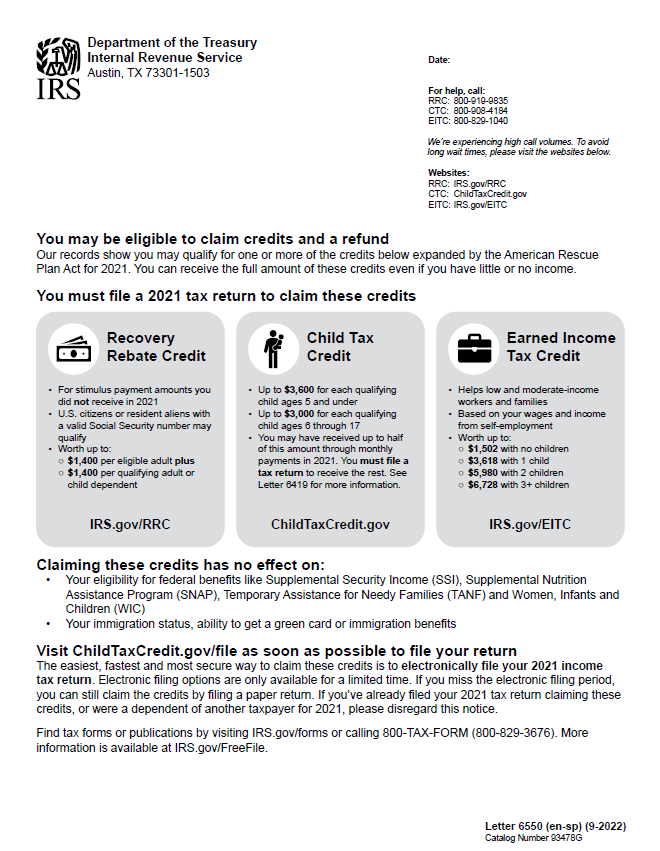
Check out this short video about IRS Letter 6550 and how families can claim the money for which they are eligible. Please share this widely with families and partner organizations!
With one month until simplified filing through GetCTC.org closes on November 15th, the IRS announced that it will send letters to over 9 million individuals and families who likely qualify for the expanded Child Tax Credit (CTC), Earned Income Tax Credit (EITC) and third stimulus payment (2021 Recovery Rebate Credit), but have yet to claim them by filing 2021 federal tax returns. These letters will start going out this week, and can help move millions of people to take action to claim their money. As a trusted source of tax information for families, the IRS is particularly well-positioned to encourage millions of families to claim the money for which they are eligible. You can help make this outreach successful by letting families know they may be receiving letters in the mail, confirming the validity of these communications, encouraging people to act now to get this money and letting them know how to do so.
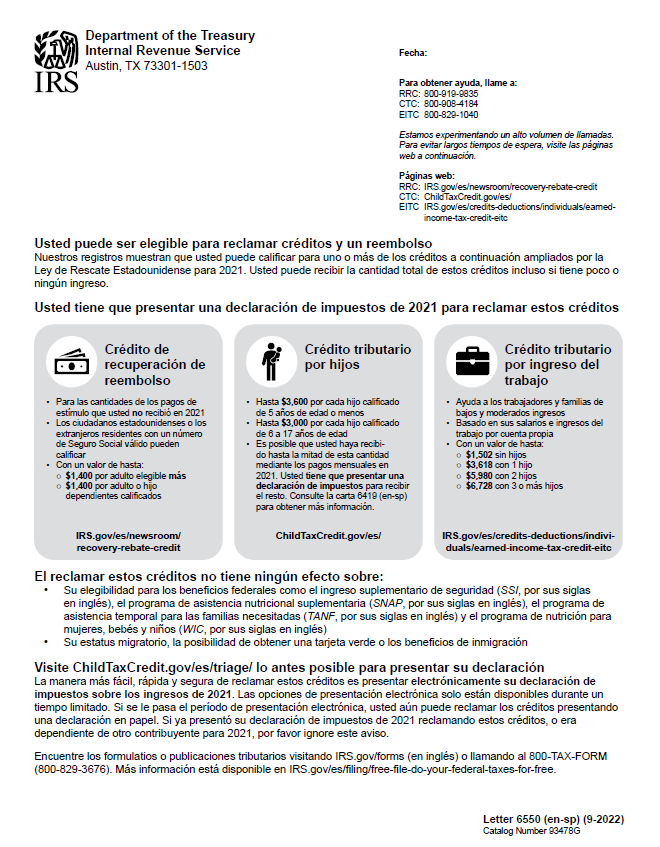
As you spread the word to families about the CTC in the coming weeks, you may receive questions from individuals who receive letters. To help you anticipate these questions, we have included a copy of IRS Letter 6550 in English and Spanish here and below. You will see that the letter alerts recipients to this opportunity, provides an overview of the available benefits and addresses common concerns.
As you will note, the letter provides a number of different links to web pages with further information about the available funds. While these web pages provide helpful information, they do not all include a clear way for families to actually claim this money. We believe you can play a critical role in addressing potential confusion by directing people to where they can file. As you interact with families in the coming weeks, we encourage you to convey the following key points about how they can get the money to which they are entitled:
- You must file a tax return to claim this money.
- To get it as quickly and easily as possible, file by November 15th.
- As indicated at the bottom of the letter, you can go to ChildTaxCredit.gov/file, to get all of the payments – even if you do not have children.
- Once you are on that page, you’ll have two options for how to get the money:
- Option 1: You can apply with a simple form on GetCTC.org. This may be a good option for you if you want a quick and easy way to apply.The site is in English and Spanish, and you can file using your phone. There’s even live chat support if you need help.
- Option 2: You can file a full tax return via IRS Free File.This option may be best for you if you feel comfortable using a computer, have all your tax documents and feel comfortable filing with limited help. This process may allow you to claim additional money, for example state credits.
After GetCTC.org closes on November 15th, families can still claim this money until 2025, but will need to file full tax returns to do so.
We know how effective it is for families to receive information from multiple trusted sources. You can spread the word about this opportunity using multilingual outreach resources like these. With just a month until GetCTC.org closes, now is the time to help families access thousands of dollars.
To learn more about the IRS’s outreach efforts and how it has identified letter recipients, check out this IRS news release.
Updated Resources to Help You Spread the Word About the Child Tax Credit Before November 15th
There are just under six weeks until simplified filing through GetCTC.org closes on November 15th. Families can continue to claim the 2021 expanded Child Tax Credit and potentially other money even after the 15th, but will need to file full tax returns to do so. You can help families get this money quickly and easily by pointing them to GetCTC.org in the next month and a half.
You do not have to be a tax expert to direct families to GetCTC.org, and our ready-to-use, updated resources make it easy for you to communicate with families however you think works best. Check out the new resource page on our website for updated resources designed to help you spread the word before November 15th. Specifically, you can find:
The flyers and sample messages are fully customizable, allowing you to include local information or add your GetCTC unique URL in order to help track your outreach impact.
These updated outreach resources were created by findyourfunds, Coalition on Human Needs, Partnership for America’s Children and Code for America.
Three Reasons to Spread the Word About the Child Tax Credit Before November 15th and Three Ways You Can Do So Now
There are just seven weeks until simplified filing through GetCTC.org closes. This online portal allows families to easily claim the 2021 expanded Child Tax Credit (CTC) on their own by November 15th. Want to learn more? Join us for a webinar on October 13th by registering here. If you miss the webinar, the recording will be posted here after the training.
Three Reasons to Help Spread the Word About the CTC Before November 15th
- Simplified filing makes it easy for families with no or low incomes to claim the 2021 CTC and potentially other money. GetCTC.org is mobile-friendly, available in English and Spanish, and designed for individuals to get through it quickly without assistance. The website also has chat support available. Individuals can continue to claim the 2021 expanded CTC until April 2025, but after GetCTC.org closes on November 15th, they will need to file full tax returns to do so. Many filers may find it challenging to get through the longer, more complicated process of filing full tax returns in order to claim the money to which they are entitled.
- In October, Code for America will launch an Earned Income Tax Credit (EITC) pilot through GetCTC.org. This means that in the final weeks of simplified filing, eligible families will be able to claim not only the CTC and third stimulus payment through GetCTC.org, but also the federal EITC.
- People need this money now. Recent reports and Census data demonstrate how the CTC reduced poverty and helped families cover the costs of basic needs, like food, child care, and more. As noted above, families who do not file by November 15th can still claim this money through full tax filing. In early 2023, Volunteer Income Tax Assistance (VITA) sites will reopen and can help people file their tax returns. Many families however, could use these funds now as they navigate back-to-school costs and anticipate the holiday season. By pointing families to GetCTC.org before November 15th, you can help families get this money as soon as possible
Three Ways to Help Spread the Word About the CTC Before November 15th
- Send out text messages, emails, robocalls and/or flyers to families you work with using resources like those on our outreach website here. Message templates and flyers are available in 11 languages. Stay tuned for the release of updated materials that you can share with families in the final weeks before GetCTC.org closes. They will be posted on our website in early October.
- Integrate announcements and resources about claiming the CTC through GetCTC.org in upcoming virtual or in-person events and meetings with families. These events may include school open houses, client meetings, and community trainings, among others. You do not have to be a tax expert to point families to GetCTC.org and to share the above-mentioned resources with families.
- Encourage school districts and state or local agencies to send text messages, emails, robocalls and/or flyers (printed or digital) to families. If you have a contact at a school district or agency that you want to invite to help spread the word about the CTC, please let us know! We can provide a template email and customized outreach materials. Please email Julia Beebe, Coalition on Human Needs: jbeebe@chn.org
What We Can Learn From Recent Reports About the Impact of the Expanded Child Tax Credit and the Ongoing Need for Outreach
With under two months until online filing through GetCTC.org closes, recently-released data and reports paint a clear picture: the expanded Child Tax Credit (CTC) reduced hardship among families with children, and outreach remains critically important to ensure that all eligible families get this money. You likely heard about the Census Bureau’s recent release of Current Population Survey and Supplemental Poverty Measure findings for 2021 and American Community Survey (ACS) 1-Year estimates for 2021. While CPS and ACS data only rely on the Official Poverty Measure, the Supplemental Poverty Measure (SPM) provides data which take into account government benefits such as the CTC. For this reason, you will note that the official poverty estimates are higher than those captured by the SPM. The SPM tells us what a significant difference the expanded CTC made in 2021, while ACS data demonstrate what would have happened without the expanded credit. The SPM data demonstrate that the child poverty rate fell 46% in 2021 to 5.2%, which is the lowest recorded SPM rate among children. The 2021 CTC alone was responsible for 5.3 million people moving out of poverty last year. Please check back soon at our “Child Tax Credit News” blog for a deeper dive into what we can learn about the impact of the 2021 CTC from the Census poverty data.
Beyond the newly-released Census poverty data, a number of recent reports highlight both the CTC’s tremendous role in supporting families and the need for continued tax credit outreach. With just weeks before GetCTC.org closes and the subsequent approach of the tax filing season, these reports, taken along with the Census poverty data, highlight why we must continue to spread the word about the CTC.
The Impact of the Child Tax Credit
In August, Children’s HealthWatch, Revolutionary Healing, and the Kairos Center for Religions, Rights, and Social Justice released a report, “ ʻI didn’t have to worryʼ – How the Child Tax Credit Helped Families Catch Up on Rent and Improved Health.” The study relied on both quantitative and qualitative methods to demonstrate the positive impact the 2021 expanded CTC had on families and children. It found that families that received the 2021 advance CTC payments were 2.66 times more likely to catch up on rent payments after they had fallen behind earlier in the Covid pandemic. The study additionally found that the advance payments increased food security, improved parental mental health and helped families pay for child care.
In another August report, “The Impact of the Enhanced Child Tax Credit on Lower-Income Households,” SaverLife, Commonwealth and Neighborhood Trust Financial Partners also highlighted the expanded CTC’s significant impact on families. They noted that this year’s larger tax refunds, including the expanded CTC, supported family financial stability, particularly in families with incomes below $20,000. In SaverLife’s Member Panel survey from May 2022, 65% of respondents with incomes under $20,000 reported that their tax refunds would make them less likely to miss utility payments. Sixty-five percent reported that their refunds would enable them to buy additional food for their families and 66% reported that this money would allow them to spend more money on essential items for their children. In an indication of just how critical the expanded CTC has been, 92% of surveyed CTC recipients predicted that a failure to extend the CTC expansion would hurt their families and anticipated increased difficulty in paying for housing, utilities, food, and other day-to-day necessities.
The findings on the expanded CTC’s positive impacts do not stop there. This month, The Center for Law and Social Policy (CLASP), University of California, Berkeley, the Center for the Study of Social Policy, the Children’s Defense Fund, ideas42, the National Women’s Law Center, Prosperity Now, UnidosUS, and the Urban-Brookings Tax Policy Center released key findings from July 2022 surveys. Their research revealed that 60% of surveyed parents in the continental U.S. who received the 2021 monthly CTC payments reported that it had become harder for their families to pay expenses since the monthly payments ceased in December 2021. Sixty-six percent of these parents reported difficulty paying for food and 65% reported difficulty paying the bills. Among Puerto Rican survey respondents, individuals who claimed the CTC reported plans to spend their tax refunds on bills and basic necessities, including food, clothes and school costs, among other daily expenses.
The Critical Need for Continued Child Tax Credit Outreach
The three above-mentioned reports also point to the importance of CTC outreach: both how it has already been effective and the need to continue spreading the word among families. In their report from last month, Children’s HealthWatch and partners note that while the CTC payments helped families, not all families could access the credit. They found inequities in receipt of the 2021 CTC advance payments by race, ethnicity, education level and tax filing status, among other factors. Indeed, the report found that families with immigrant parents were 42% less likely to receive the advance payments, underscoring the importance of continued CTC outreach in immigrant communities.
In their report, “The Impact of the Enhanced Child Tax Credit on Lower-Income Households,” SaverLife and partners focused on the second half of the CTC (claimed through filing 2021 tax returns this year). They identified some of families’ misconceptions and fears that may prevent them from claiming the CTC. Forty-one percent of surveyed CTC recipients reported that this tax season was more confusing than in prior years and 40% reported they had filed later than they typically do. Sixty percent of those who reported filing later than usual referenced more confusion this tax season, including insufficient communication about the CTC, while 51% reported they filed later because of concerns about owing money back. Ultimately, among those surveyed who anticipated owing money to the IRS, 44% received refunds instead. The report found that recipients generally received bigger tax refunds than expected. This research points to the need for continued CTC outreach to address common concerns we have encountered among potential filers, including anxiety about owing money to the IRS and general uncertainty about eligibility. You can find frequently asked questions and responses from the IRS here.
Finally, the key survey findings from CLASP and partners point to both good news about the tax credit outreach that has already occurred, and the need for continued outreach in the coming months. The survey revealed that between October 2021 and July 2022, the CTC take-up rate increased from 64% to 75% among Hispanic parents in the continental U.S. In the context of the above-referenced inequities in claiming the CTC among families with immigrant parents, this increase in take-up among Hispanic parents points to community partners’ critical outreach efforts. In another piece of good news, survey results revealed that 88% of Puerto Rican respondents had heard about the CTC before participating in the survey, again pointing to effective outreach and awareness efforts. While these figures reflect the importance of outreach that has occurred during the past year, there remain gaps. The study found that white parents claimed the CTC at higher rates than Black or Hispanic parents, even with the noted progress among Hispanic filers. In Puerto Rico, those with higher levels of education claimed the CTC at higher rates, as did married parents. Respondents who had not claimed the CTC (and did not plan to do so) reported thinking they were ineligible for the credit or not knowing about it. Again, this points to the need for ongoing outreach.
We hope that you will join us in continuing to spread the word about the CTC! If you are new to CTC outreach, please check out our website for resources and recent webinar recordings. For questions, please contact Julia Beebe or Aline S. da Fonseca.